Lucien Capet, French Violinist, Chamber Music, and Violin Pedagogue (1873-1928)
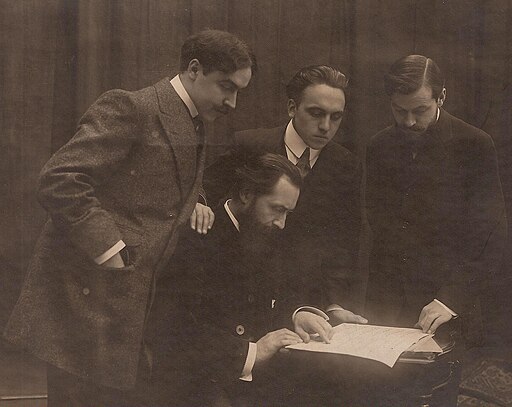
The great French violinist, writer, and pedagogue with his string quartet – Capet is pictured seated, second from the left
Described by Marc Pincher and Robert Phillip in the New Grove Dictionary of Music and Musicians as a great violinist ‘equally renowned as a teacher’, ‘especially of bowing technique’, and in a manner similar to the Czech violinist Otokar Sevcik’s (1852-1934) groundbreakingly comprehensive work for the violinist’s left hand, the great French violinist and teacher Lucien Capet was born in Paris in 1873. Later a pupil at the Paris Conservatoire, studying with Jean-Pierre Maurin (1822-1894), himself the student of the great Pierre Baillot (1771-1842), Capet later rose through to become the director of the Institut de Violin in Paris. One one of France’s most esteemed violin pedagogues, violinists, and chamber musicians, his legacy can be felt all over the world, and through some exceedingly insightful work on the art of violin bowing, as well as through his historically-inflected approach to violin playing, also groundbreaking for his time.
Capet also worked in chamber music, with which he would perform in a manner that sought to educate through the performance of historically-inflected music that traced violin development over time. His work in chamber music extended to the founding of a string quartet, and into thoughtful programming that explored the history of music through the history of the string quartet. The quartet focussed also especially on some transitional works and times, through, for example, the Beethoven string quartets, and would often trace the entire arc of string quartet repertoire from Classical to Romantic – with playing and vibrato styles carefully and accurately altered to match the likeness and veracity of each period of music out of which the music emerged; an especially early instance of period-relating performing.
With a playing style charactised, as Pincher and Philip also noted, by advanced historical and compositional veracity and vitality – and by ‘faithfulness to the composer’s score, purity of tone, and finesse’ rather than a sheer ‘force of expression’, Capet’s musical subtleties and sensibilities extended also to a highly focussed and organized set of violin and musical writing.
Like many of the violin pedagogues documented in this collection and compilation – also available more comprehensively as an e-Book and through more detailed standalone articles – Capet is known for a pedogogical approach that involved both teaching in person as well as having his pedagogical views documented in written and published form. Authoring, also, a work on Beethoven’s string quartets, for example, Capet’s work extended extended to a legendary work on violin bowing, called Superior Bowing Technique – a landmark work in the field, particularly as pedagogical attention is often paid to the left instead of the right side of violin performance practice. Cataloguing with subtlety and great insight thoughts on teaching and bowing methods, as well as thoughts on tone production and development, a contemporary, Carl Flesch, noted how it was a critical and ‘important work’, a view long held and still held today.
Some of the students taught by Capet and this work on advanced or superior violin technque, and techniques in the plural, include the great violin pedagogue Ivan Galamian, who taught many of his exercises to his students, including his teaching assistant and the equally esteemed Dorothy DeLay, as well as Curtis Institute of Music professor Jascha Brodsky, who taught students like the great American violinists Leila Josefowickz and Hilary Hahn. As Boris Schawrz, student of Capet, also noted in 1983, and in Great Masters of the Violin, Capet was ‘rather atypical French’ in his emphasis on ‘logic, reflection, and painstaking […] attention to detail’, particularly in his writings on the bow, which makes his work a fine read for those hoping to advance and deepen their sings into bowing and bowing expertise in a detailed, advance, illuminating, and practical way.
A must-read, Superior Bowing Technique is a must-have for every violin collection today, and stands as a unique form of violin pedagogy in which technical aspects are carefully and comprehensively collated and written down for reference and use both inside as well as outside of the classroom, and for all times and places.
For more links to books and educational material on Capet and DeLay, as well as copies of the material, please feel free to contact us for sale by email or through the contact form.
By Orion Music and Arts, Cambridge MA, 2023-2024
Copyright, ©, Orion Music and Arts Cambridge MA, All Rights Reserved
All Rights Reserved


 Violin Resources - A Performing, Learning, Artistic, and Teaching Web Resource and Platform for Violinists and Musicians, By Orion Music and Arts, Cambridge, MA, est. 2023
Leave a comment