Shinichi Suzuki – Memory, Personal Experience, and Moral Integrity in Violin Pedagogy
Utsukushi oto ni gnocchi o – Beautiful tone with life and spirit, please
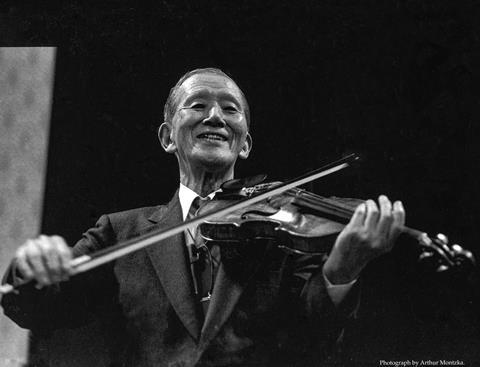
Dr. Shinichi Suzuki – Violinist, Composer, Educator, and Violin Pedagogue
Developer of the world renowned and critically acclaimed Suzuki Violin Method which has allowed for the education of young violinists the world over, Dr. Shinichi Suzuki was born in 1898 in Nagoya, Japan, as one of twelve children born to a family of violin makers.
Early History with Violins
The Suzuki violin factory which belonged to his parents, made for a place of wonder for Suzuki’s early years, wandering around scores and scores and scores of violins, large and small; all of which he developed a personal and enduring closeness through sheer volume and personal contact, at a young age, and that little can claim.
Self-Learning
Taking a violin home, Suzuki taught himself to play, simply through listening, to recordings or broadcasts, and then trying to imitate what he learnt, and learned by heart, back in a time of political and global upheaval and travail that did not make personal lessons easily possible.
Time in Germany and Pedagogy Development
Progressing so swiftly that he later left for Germany further to the study the instrument, Suzuki later pioneered a violin teaching and learning method that incorporated his own personal life and experience – a pedagogy that would combine extreme large scaled performance and/or instruction – one Suzuki concert, for example, had around 500 students play a Vivaldi concerto accurately and miraculously in technical and musical tandem – with his own personal teaching and learning experience that evolved teaching and learning the violin through naturalistic methods like listening and mirroring.
Moral and Intangible Values
In addition, as music and educational psychologists like Merlin Thompson have written, Suzuki held moral and intangible aspects of music like beauty, life, and even truth as essential and integral to violin development and sound.
Putting as foremost ‘authenticity’ and the importance of ‘beautiful tone with living sound’, Suzuki’s music was filled with a notion of the just, noble, and beautiful, with even abstract qualities like truth as integral to violin development and sound.
Further Information
For more educational and violin material on Suzuki and his violin teaching and performing style, please feel free to contact us with the contact form. Additional educational notes, packages, and performances are also available for affordable sale. Please email to ask.
Article by Orion Music and Arts, Cambridge MA
By Orion Music and Arts, Cambridge, MA, 2023-2024
Copyright, ©, Orion Music and Arts Cambridge MA, All Rights Reserved
All Rights Reserved


 Violin Resources - A Performing, Learning, Artistic, and Teaching Web Resource and Platform for Violinists and Musicians, By Orion Music and Arts, Cambridge, MA, est. 2023
Leave a comment